How to Import Bank Transactions into QuickBooks Online (U.S)?
March 3, 2026
Import Bank Transactions into Quickbooks Online
You can import bank statements from text files or Excel spreadsheets directly into QuickBooks Online using SaasAnt Transactions (Online) software.
Pre Requisites:
Connect your QuickBooks Online account to SaasAnt Transactions (Online) App from QuickBooks AppStore by clicking the "Get App Now" button and get the 30 days free trial [No credit card required].
How does QuickBooks Bank Statement Import work?
Let's assume that we have a file that contains the following bank statement.
Date | Description | Check No | Amount |
23/12/18 | Subscription payment | 12123733 | 100 |
23/12/18 | Telephone Bill Payment | 2121221 1 | -900 |
Bank Statement has Deposit and Expenses. To import Deposits and Expenses (Checks) into QuickBooks, we need to mention
1. Income Accounts
2. Expense Accounts
3. Customer or Vendor Names
Let's modify the file to add the above details.
Date | Description | Check No | Amount | Account | Payee |
23/12/18 | Subscription payment | 12123733 | 100 | Uncategorized Income Account | John |
23/12/18 | Telephone Bill Payment | 2121221 1 | -900 | Telephone Expense Account | Telephone Company 1 |
Now we can import this file using SaasAnt Transactions (Online).
If the transaction has a POSITIVE Amount, it will be considered as Deposit.
If the transaction has a NEGATIVE Amount, it will be considered as an Expense/ Check.
If you want to change the Transaction Type, then you can add one more column Transaction Type and mention one of the below value
1. Check
2. Expense
3. Deposit
How to Import Bank Transactions into QuickBooks Online using SaasAnt Transactions Online
To import bulk/batch bank transactions into QuickBooks Online using the SaasAnt Transactions (Online) application, follow the steps below,
1) Login into SaasAnt Transaction Online
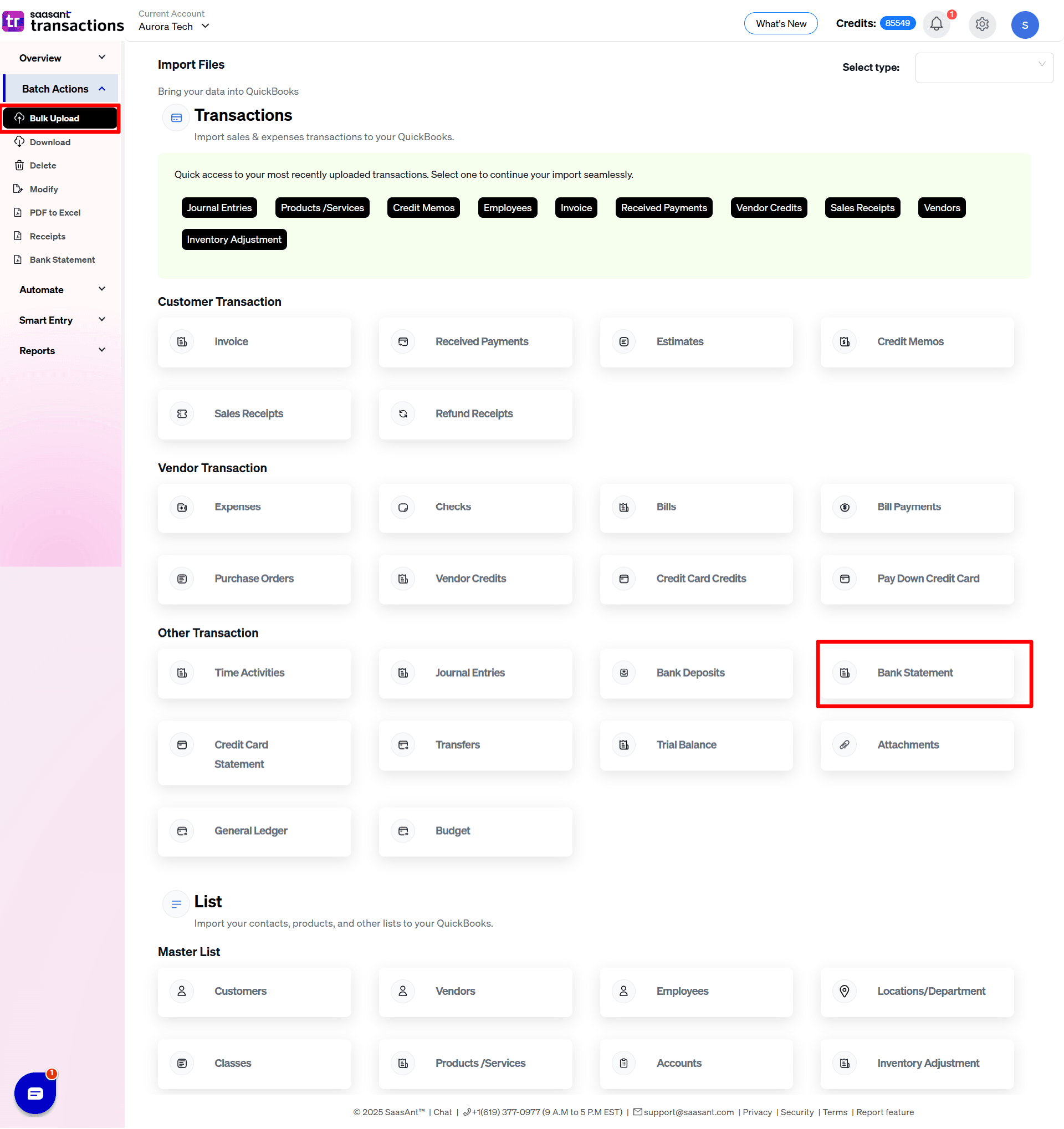
2) Select the Bulk Upload Tab.
3) Select the QuickBooks entity as Bank Statements
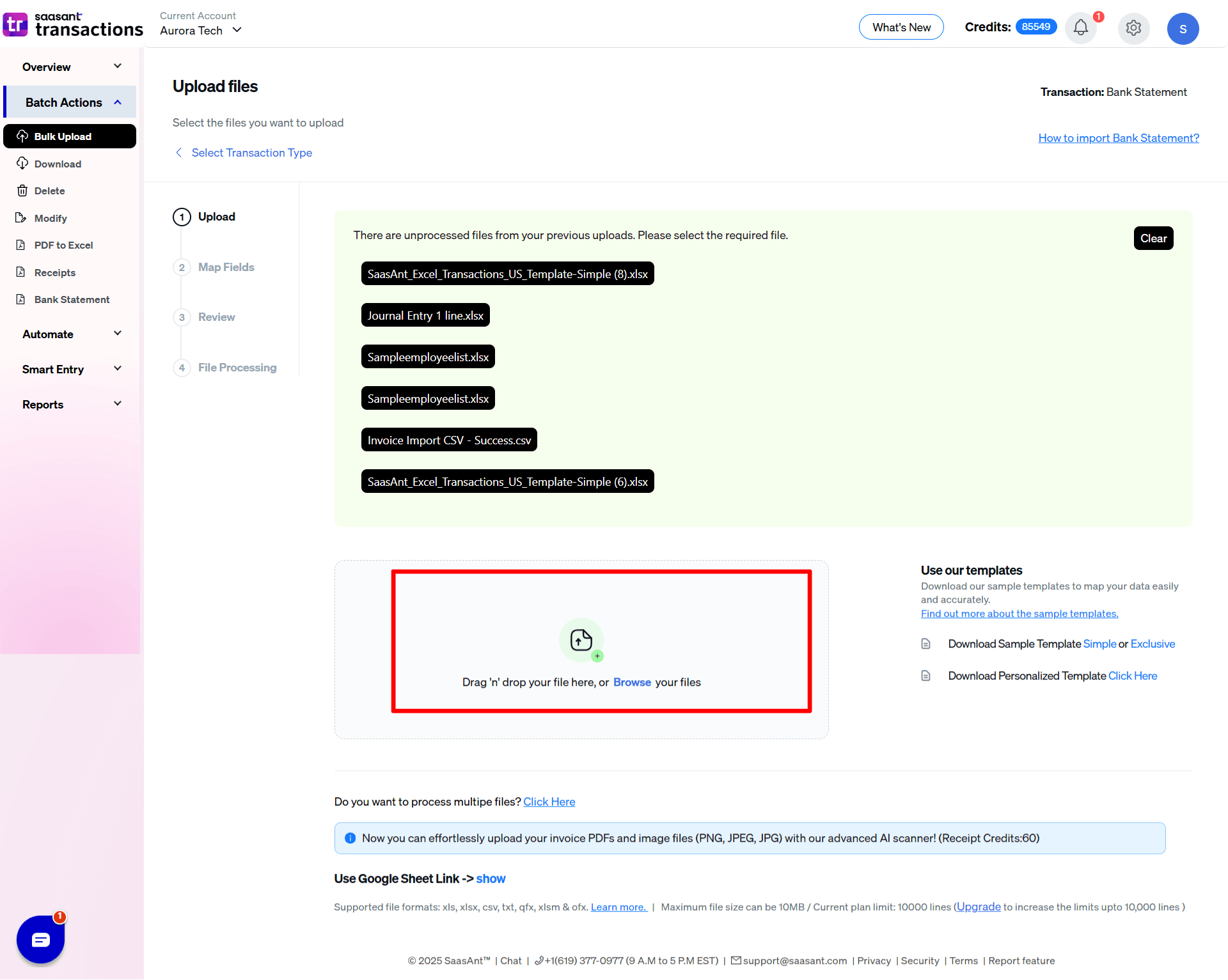
4) Select the files you want to upload
5) Set up the Mapping of the columns in your Bank statement
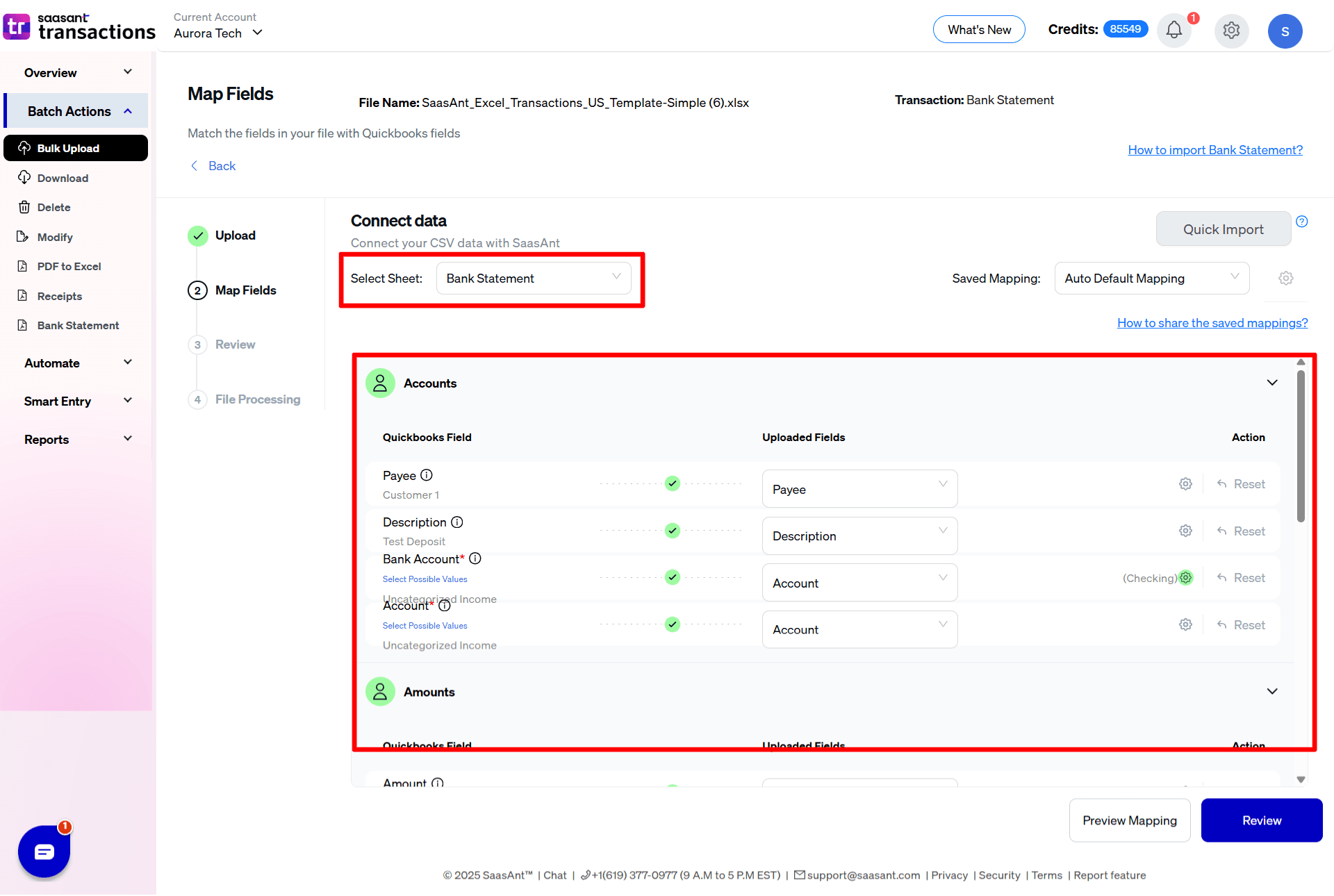
Select the "Preview Mapping" button to visualize current mapping based on QuickBooks
7) Select the Upload Tab
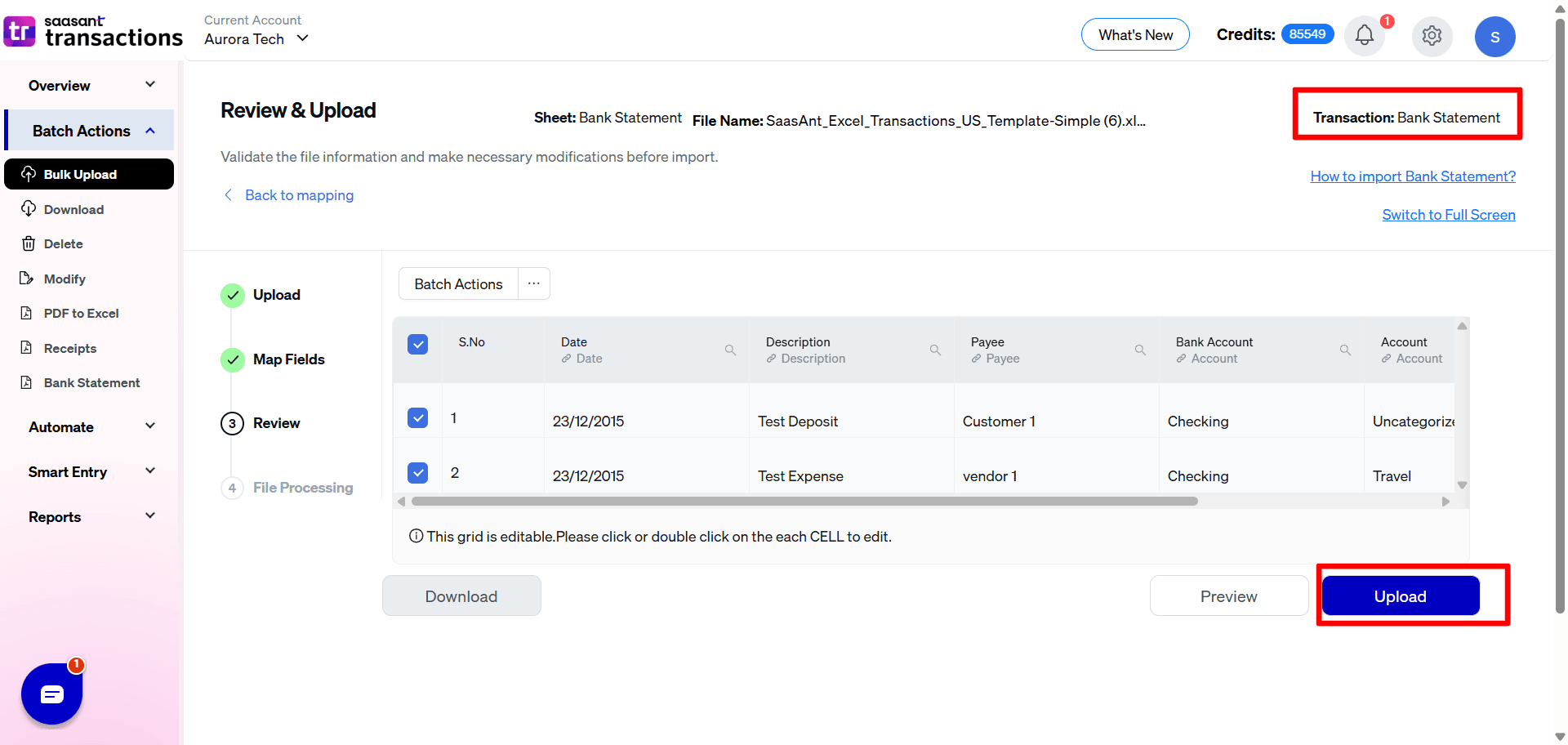
8) The data was imported successfully into QuickBooks.
SaasAnt Transactions (Online) Fields
Field Name | Format | Description |
|---|---|---|
Check No | 21 Characters | Check Number or Reference number for the transaction. |
Payee | Characters | Name of the vendor / Customer / Employee for this transaction. |
Bank Account | Characters | Name of the Bank / Credit Card / Cash Account for this transaction. |
Date | Date | The date entered by the user when this transaction occurred. |
Description | 4000 Characters | The Description of the Expense or Deposit Transaction. |
Account | Characters | Reference to the Expense Account Name or Income Account Name associated with the transaction. |
Amount | Decimal | The amount of the transaction. |
Credit Amount | Decimal | Deposit Amount |
Debit Amount | Decimal | Expense/ Check Amount of the transaction |
Transaction Type | Characters | Type of the transaction. |
Bank Statement Settings Reference Guide
The Bank Statement Settings panel controls the core automation rules, date configurations, formatting parsing, and ledger lookups used exclusively when importing bank or credit card statement files.
Automation & Workflow Rules
Do you want to apply suggestions automatically?
What it does: Allows SaasAnt to use automated logic and fallback values to fill in minor data gaps or map close matches during the statement import. It processes the transaction smoothly while generating a warning log for your review.
Do you want to create Customers, Vendors, Locations, Classes, and Accounts automatically?
What it does: Serves as the master background creation switch. If your bank statement introduces a brand-new entity name (such as a new vendor or utility company), enabling this allows SaasAnt to instantly build that profile in QuickBooks during the import to prevent validation errors.
Do you want to skip the mapping screen?
What it does: Bypasses Step 2 completely on future statement uploads. If your bank export files use a consistent, recognized template layout, this allows you to go straight from file upload to data review.
Formatting & Performance Controls
Date Format
What it does: Sets the specific date structure (supporting - or / separators) to tell the system's parser exactly how to read your statement's date column (e.g., DD/MM/YYYY), preventing day and month confusion.
Do you want to use the Transaction Reference Numbers from the uploaded file?
What it does: Instructs QuickBooks to retain and log the exact transaction or reference IDs pulled directly from your bank statement file rather than replacing them with native system-generated sequence numbers.
Do you want to disable the optimisation for the batch import?
What it does: Turns off high-speed parallel processing bundles in favor of a meticulous, line-by-line verification import. This is typically used for auditing or troubleshooting complex statement lines.
Do you want to receive alerts/notifications about your automation imports?
What it does: Controls background email summary notifications. When enabled, the system sends you an email breakdown detailing how many statement transactions successfully posted, how many failed, and the specific reasons behind any errors.
Ledger Lookups
Find GL Account by Account Number
What it does: Configures SaasAnt to match your bank, credit card, or expense ledgers using their numerical chart of account codes (e.g., 1100, 2100) rather than searching for matches based on text account names.
FAQs
What file types does SaasAnt Transactions Online support for QuickBooks Online imports?
For almost all entities in QuickBooks Online, SaasAnt Transactions Online supports XLS, XLSX, XLSM, CSV, TXT, Google Sheets, and IIF. Additionally, PDF, PNG, and JPEG are supported only for Receipts, Invoices, Bank Statements, Checks, and Expenses.