How to Import Credit Memos into QuickBooks Online (U.S)?
February 3, 2026
You can import bulk credit card memos from text files or Excel spreadsheets directly into QuickBooks Online using SaasAnt Transactions (Online) software.
Pre Requisites:
Connect your QuickBooks Online account to SaasAnt Transactions (Online) App from QuickBooks AppStore by clicking the "Get App Now" button and get the 30 days free trial [No credit card required].
Video Tutorial for Importing Credit Memos into QuickBooks Online using SaasAnt Transactions Online:
How to Import Credit Memos into QuickBooks Online using SaasAnt Transactions Online
1) Login into SaasAnt Transaction Online
2) Select the Bulk Upload Tab.
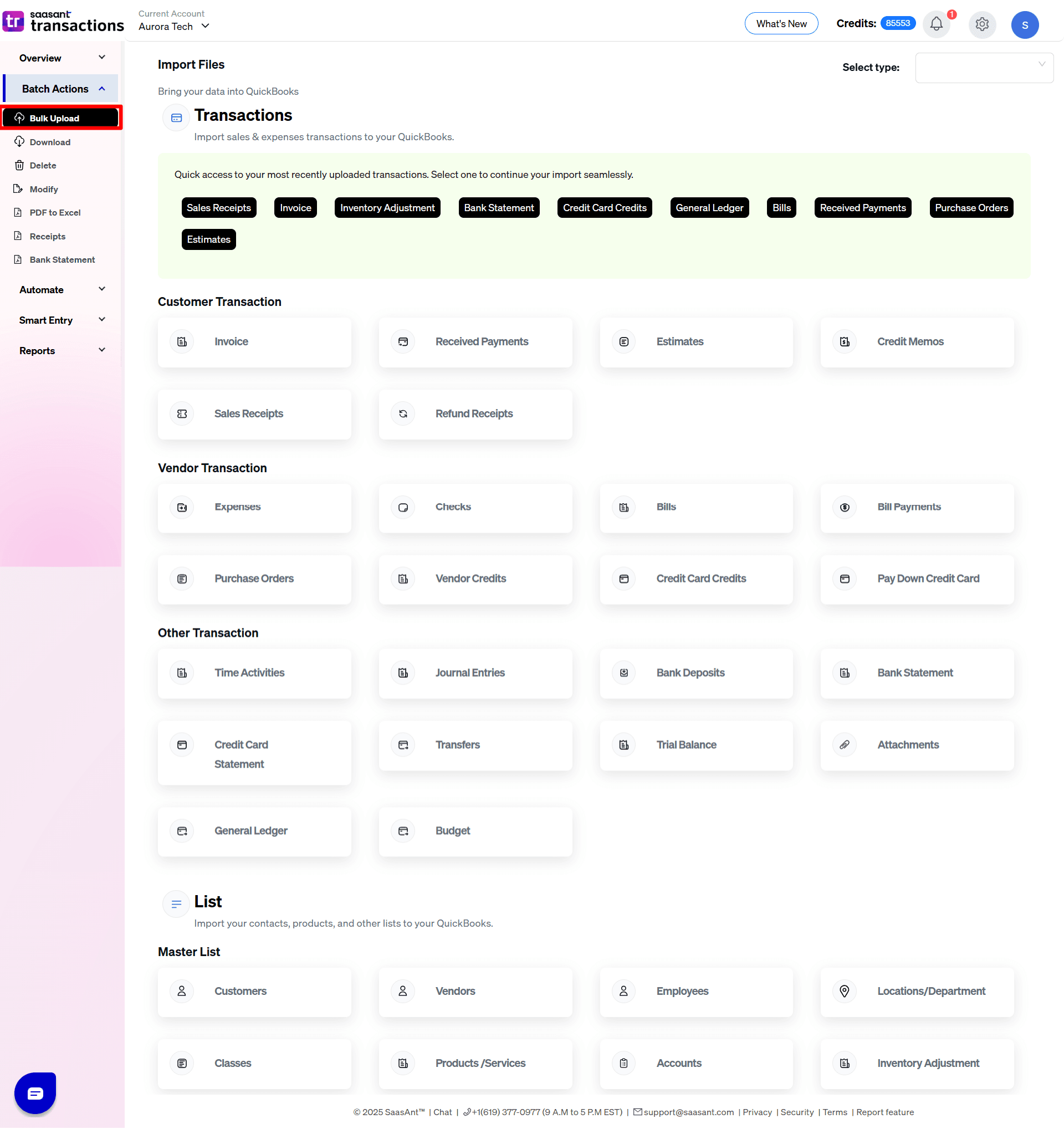
3) Select the QuickBooks entity as "Credit Memos".
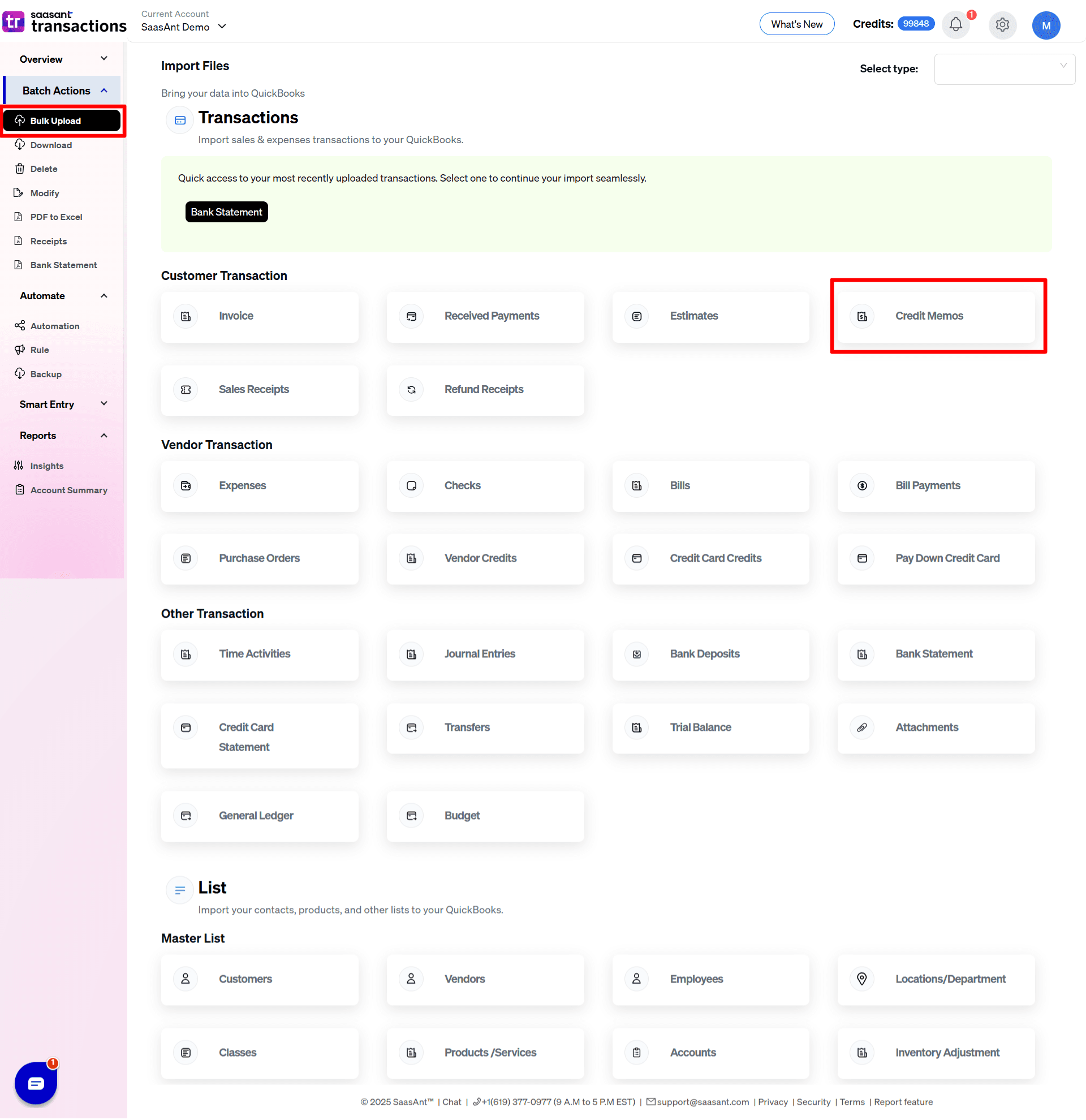
4) Select the files you want to upload.
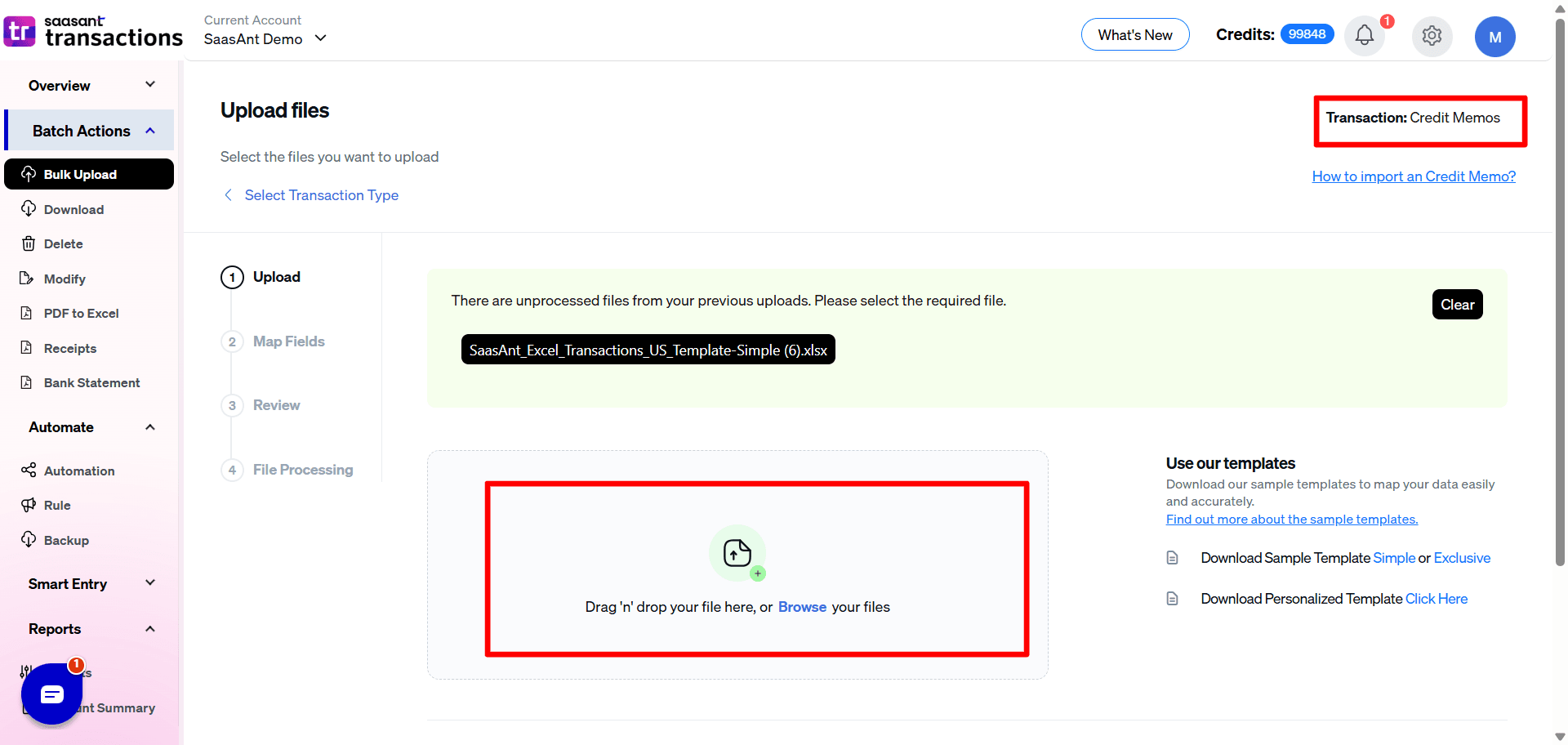
5) Set up the Mapping of the columns in your Credit Memos.
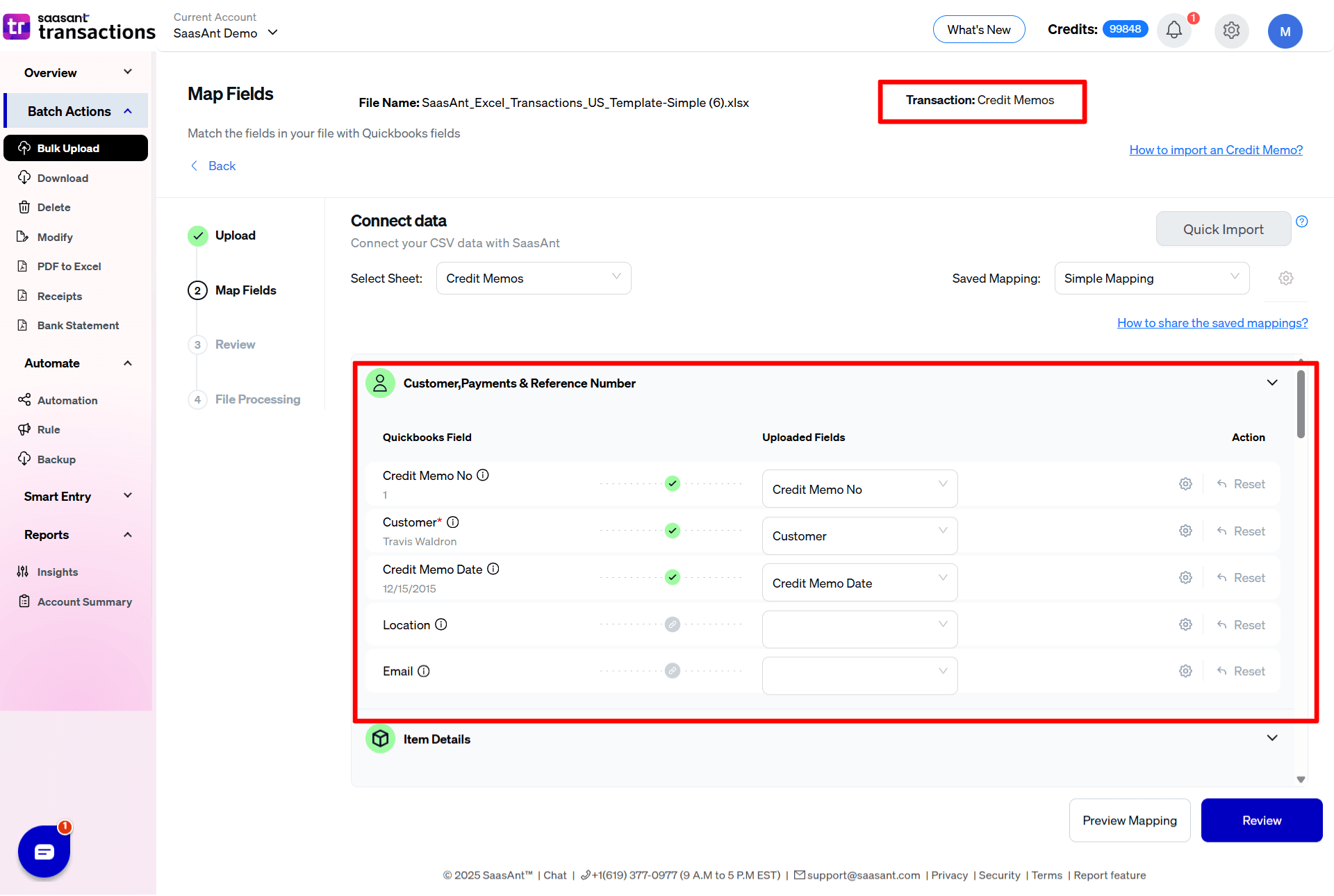
6) Select the "Preview Mapping" button to visualize current mapping based on QuickBooks.
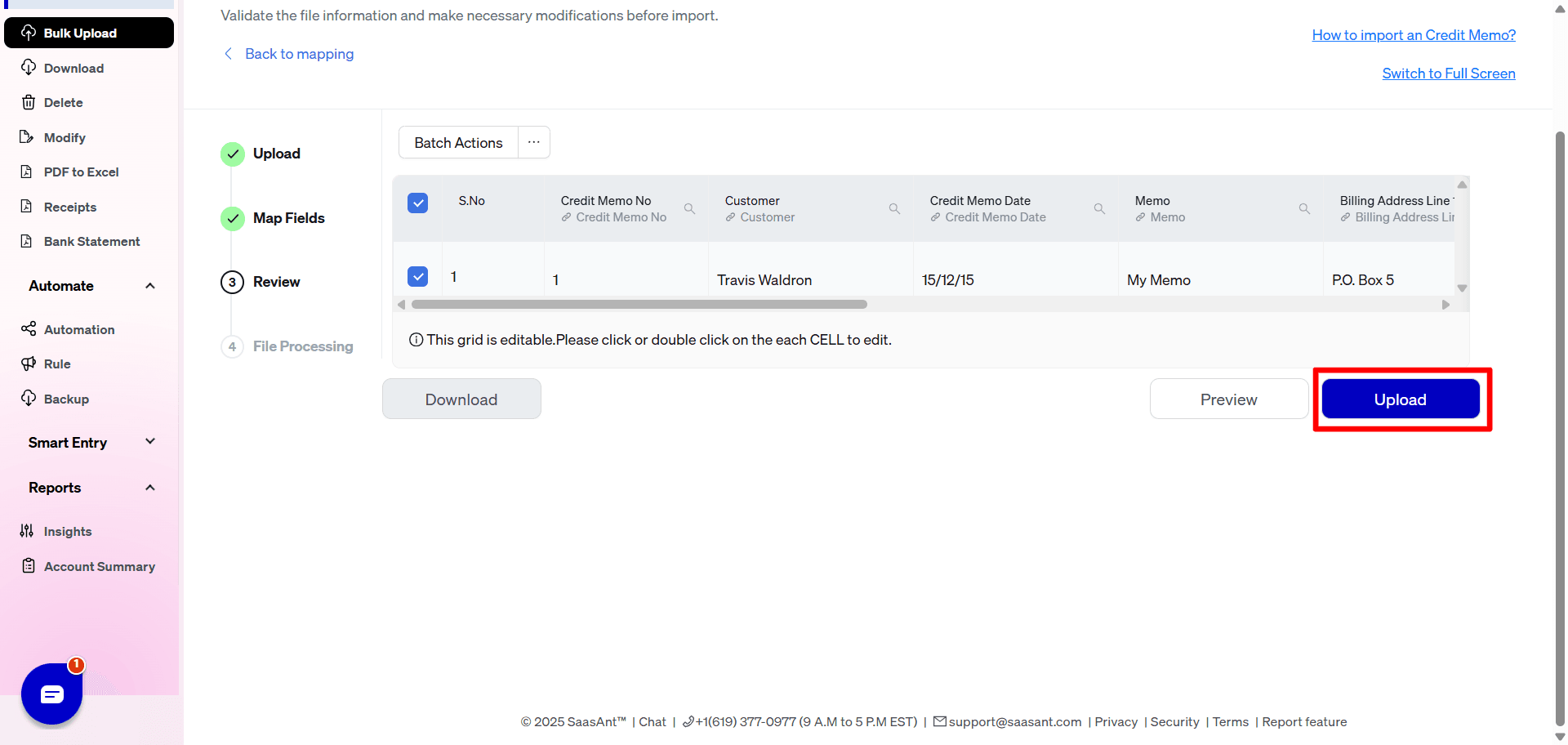
7) Select the Upload tab.
8) The data was imported successfully into QuickBooks.
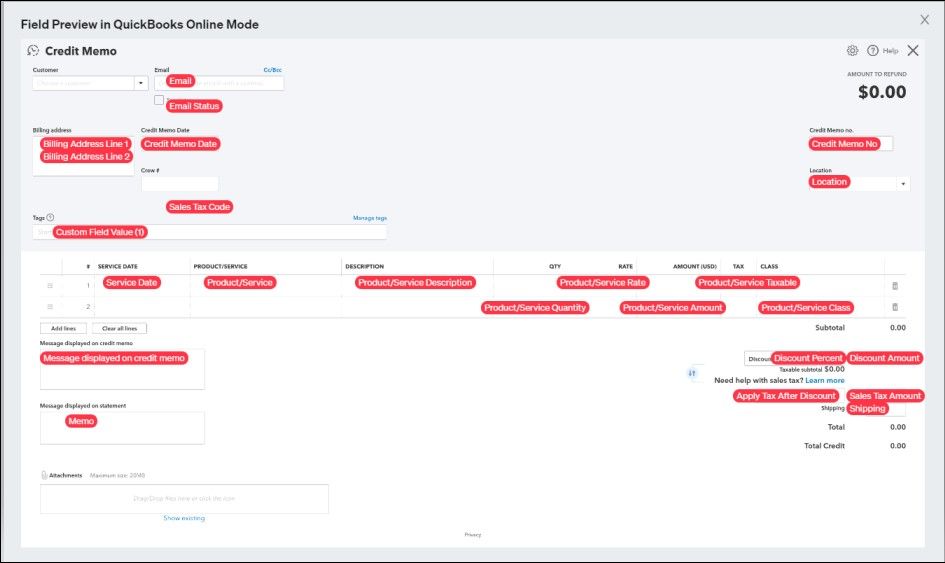
Let’s have a look at the SaasAnt Transactions Online Fields.
SaasAnt Transactions Online Fields
Field Name | Format | Description |
|---|---|---|
Credit Memo No. | 21 Characters | Reference number for the transaction. By default, this value is used only for internal processing by SaasAnt Transactions (Online), and QuickBooks auto-generates a new value. This can be changed in the import settings. |
Customer | Characters | Name of the customer. |
Credit Memo Date | Date | Date of the transaction. |
Memo | 4000 Characters | Organization-private note about the transaction. This note will not appear on the transaction records by default. |
Shipping | Decimal | The shipping amount for this transaction. |
Sales Tax Code | Characters | The TaxCode associated with the sales tax for the transaction. |
Sales Tax Amount | Decimal | Total tax amount for this transaction. |
Discount Amount | Decimal | The discount amount. You may enter either a discount percent or a discount amount. If the percent is specified, it will override the amount. |
Discount Percent | Decimal | Percentage by which the amount due is reduced, from 0% to 100%. To enter a discount of 8.5% use 8.5, not 0.085. You may enter either a discount percent or a discount amount. If the percent is specified, it will override the amount. |
Discount Account | Characters | |
Service Date | Date | Date when the service is performed. |
Product/Service | Characters | Name of Product/Service |
Product/Service Description | 4000 Characters | |
Product/Service Quantity | Decimal | Number of items for the line. |
Product/Service Rate | Decimal | |
Product/Service Amount | Decimal | |
Product/Service Taxable | Boolean | If true, marks the line amount for tax calculation. |
Product/Service Class | Characters | The Class name associated with this line. |
Print Status | Boolean | The Print status |
Email Status | Boolean | The Email status |
Message displayed on credit memo | 1000 Characters | User-entered message to the customer; this message is visible to end user on their transactions. |
Location | Characters | |
100 Characters | Email address. The address format must follow RFC 822 standard. | |
Apply Tax After Discount | Boolean | If false or null, calculate the sales tax first, and then apply the discount. If true, subtract the discount first and then calculate the sales tax. |
Custom Field Name (1) | 15 Characters | Name of the custom field. |
Custom Field Value (1) | 31 Characters | Value of the custom field. |
Custom Field Name (2) | 15 Characters | Name of the custom field. |
Custom Field Value (2) | 31 Characters | Value of the custom field. |
Custom Field Name (3) | 15 Characters | Name of the custom field. |
Custom Field Value (3) | 31 Characters | Value of the custom field. |
Currency Code | Characters | Reference to the Currency in which all amounts on the associated transaction are expressed. |
Exchange Rate | Decimal | Default is 1, applicable if Multi-Currency is enabled for the company. |
Credit Memos Settings Reference Guide
The Credit Memos settings panel governs how customer return credits, transaction reference formatting, and default account mappings are handled when importing negative sales adjustments into QuickBooks.
Global Automation & Date Parsing
Do you want to apply suggestions automatically?
What it does: Uses automated matching logic and historical fallback parameters to fill minor data gaps or map close matches, keeping your credit memo import moving smoothly.
Do you want to create Customers, Vendors, Locations, Classes, and Accounts automatically?
What it does: Acts as a master background creation switch. If a credit memo row references a brand-new customer profile or location that doesn't exist yet, this allows SaasAnt to build it on the fly to prevent validation errors.
Date Format
What it does: Configures the system parser to correctly read your transaction date column (e.g., DD/MM/YYYY) so days and months are never transposed.
Reference Numbers & Processing Controls
Do you want to use the Transaction Reference Numbers from the uploaded file?
What it does: Instructs QuickBooks to record the explicit credit memo numbers provided in your spreadsheet instead of overwriting them with native, auto-sequenced reference numbers.
Do you want to disable the optimisation for the batch import?
What it does: Turns off parallel processing in favor of a slower, line-by-line verification import—highly useful for auditing complex credit entries.
Customer & Product Mapping Overrides
Do you want to Update the address (Customer & Vendor) in QuickBooks from the file?
What it does: Overwrites the existing billing or shipping address data saved in your QuickBooks customer profiles with the new address details found in your upload file.
Do you want to identify product details from SKU information?
What it does: Tells the system to match any associated line items or credited products using their unique QuickBooks SKU field rather than relying on Item Name matches.
Would you like to match the names exactly as they appear in your file for customers, vendors, and items?
What it does: Strips out variations in spacing, casing, or trailing characters to require a strict, character-by-character text match.
Automated Product/Service Creation Rules
If your spreadsheet introduces inventory or service items that do not yet exist in your QuickBooks records, SaasAnt will automatically generate them on the fly using these default fallback accounts:
Select the product type to be created automatically if it does not exist
What it does: Establishes the default item categorization tier (such as Non-Inventory or Service) for brand-new items generated on the fly.
Select the Income Account for the newly created Products/Services
What it does: Maps the default revenue/sales ledger account where adjustments from this item should be tracked.
Select the Expense Account for the newly created Products/Services
What it does: Maps the default expense or Cost of Goods Sold (COGS) ledger account for tracking procurement costs.
For Automated Inventory Items:
Select the Inventory Account for the newly created Inventory Item
What it does: Maps physical stock adjustments directly to your preferred 'Inventory Asset' ledger account in QuickBooks.
Select the Inventory Start Date for the newly created Inventory Item
What it does: Establishes the official tracking start date (MM/DD/YYYY) for the item's stock history.
Select the default Inventory Quantity for the newly created Inventory Item
What it does: Automatically inputs an initial opening stock quantity balance.
Find GL Account by Account Number
What it does: Forces SaasAnt to look up and map your chart of accounts using their exact numerical codes rather than full text account names.
Possible Failures & Troubleshooting Tips
The currency of the transaction is invalid for customer / vendor / account.
The given Currency is different than the default currency of the vendor. Please refer the Vendor's Currency in QuickBooks & update the same currency in Currency Field. It is possible that Multi Currency feature in QuickBooks could be disabled. Please enable the feature.
Duplicate Document Number Error : You must specify a different number. This number has already been used.
There is an another Credit Memo has the same reference number.Please use the another reference number.
You have disabled "Assign the Estimate / Invoice / Journal Entry / Sales Receipt Numbers automatically" in Import Settings. By enabling this feature, QuickBooks will automatically assign numbers for the transaction.
Amount is not equal to UnitPrice * Qty supplied value.
The given Quantity & Rate is not equal to given Amount. Please verify those fields.
You can’t set both an amount and a discount percentage if the amount is not the sum of the discount percentage and the subtotal.
The given Quantity & Rate is not equal to given Amount. Please verify those fields.
Email Address does not conform to the syntax rules of RFC 822.
Kindly verify the given email address format. It should be in xxxx@xx.xx format.
Amount is missing in the request.
The Line Item amount is missing for the particular line item.
Please select a tax code for the shipping line.
Kindly provide the valid tax code in Shipping tax Code Field.
No matching reference found for this customer.
There is no match found for given Customer Name.
Please enable "Auto Creation of List Entities" feature in import settings to create the customer automatically.
Transaction amount (Sum of line amounts) must be 0 or greater.
Please provide the valid amounts (Non Negative) in Line Item Amount Field.
The discount amount must be non-negative.
Please provide the valid amounts (Non Negative) in Discount Amount Field.
Transaction amount (Sum of line amounts) must be 0 or greater.
Please provide the valid amounts (Non Negative) in Line Item Amount Field.
The discount amount must be non-negative.
Please provide the valid amounts (Non Negative) in Discount Amount Field.
FAQ
What file types does SaasAnt Transactions Online support for QuickBooks Online imports?
For almost all entities in QuickBooks Online, SaasAnt Transactions Online supports XLS, XLSX, XLSM, CSV, TXT, Google Sheets, and IIF. Additionally, PDF, PNG, and JPEG are supported only for Receipts, Invoices, Bank Statements, Checks, and Expenses.